The Warning Gap: Why Marine Hazard Technology Needs One Connected Public Network
As new shark alerts, drone programs and beach safety tools move forward, Beach Buddy says the public still needs one place to receive, understand and act on marine hazard information.
Marine safety is changing.
Shark attack alerts are moving into the national emergency alert conversation. Coastal cities are launching drone programs. Researchers continue tracking sharks. Lifeguards, agencies and the public are reporting hazards. Beach advisories, warning flags, weather alerts and ocean safety updates are all part of the growing effort to protect people near the water.
All of that progress matters.
But there is still a dangerous gap.
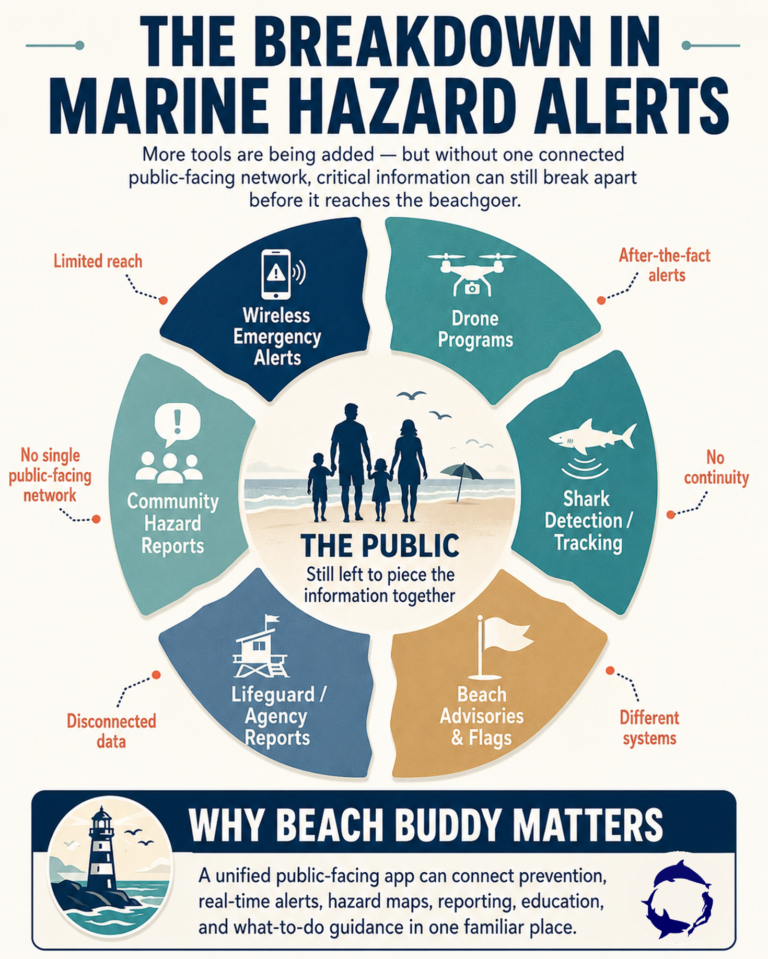
The problem is not that new marine hazard technology is unnecessary. It is very necessary. The problem is that every new alert, drone program, shark detection tool, agency report or local warning system can become another separate piece of information unless there is a connected public-facing network to bring it together.
That is the gap the Beach Buddy app was built to bridge.
The Brief
New marine safety tools are advancing, including shark attack alerts, drone response programs, shark tracking, beach advisories and public reporting.
Each tool can help, but if they remain disconnected, beachgoers may still be left trying to piece together critical information from different places.
Wireless emergency alerts can warn people near a confirmed emergency, but they do not create a full prevention, education, reporting, mapping and data network.
Beach Buddy is designed as a public-facing marine hazard prevention and alert app that connects real-time awareness, hazard reports, maps, app-based alerts, incident data and what-to-do guidance.
Safe Ocean Project says the time to build one connected marine hazard network is now, before communities spend years creating separate systems that do not speak to each other.
Progress Is Happening, But So Is Fragmentation
The movement toward better shark and marine hazard awareness is no longer theoretical.
The recent national push to allow shark attack alerts through the Wireless Emergency Alert system is a major step forward. It recognizes something families, survivors, ocean users and safety advocates have known for years: when a serious marine hazard occurs, people nearby need to know as quickly as possible.
At the same time, local agencies are investing in new technology. Virginia Beach recently launched a “Drone as First Responder” program at the Oceanfront to provide real-time aerial views of serious emergencies before officers arrive. Programs like this show how quickly public safety is becoming more technology-driven.
These efforts should be supported.
But they also reveal the next problem.
A drone can see something. A shark detection system can record something. A lifeguard can report something. A beach advisory can be posted. A wireless emergency alert can warn phones in a targeted area. A local agency can store information internally.
But what happens when those systems do not connect?
What happens when a family is driving to that beach and would want to know before they arrive?
What happens when someone is monitoring a beach because their child, spouse or friend is there?
What happens when the warning is sent only to phones within a specific alert area, but the people who need to make decisions are outside that radius?
What happens when the information comes after an attack, but there were earlier signs, reports or conditions that could have helped someone make a safer choice before entering the water?
That is the warning gap.
Alerts Are Not the Same as Prevention
Emergency alerts are important. They can save lives.
But an alert after an incident is not the same as prevention before an incident.
If a shark attack alert reaches phones only after someone has already been bitten, then the public has been warned, but prevention has already missed its first chance.
That does not make the alert unimportant. It means the alert is only one piece of the safety chain.
Beach Buddy was designed around the full chain: before, during and after a marine hazard.
Before a beachgoer enters the water, the app can help them understand local conditions, nearby hazards, recent reports and risk factors.
During a hazard, the app can support real-time awareness through app-based alerts that can be sent to SmartWatches, warning information and hazard mapping.
After a report or incident is created, the information can be logged as structured data instead of disappearing after the warning fades.
That matters because marine hazard information should not vanish when the alert ends. It should help inform future awareness, public education, pattern recognition and prevention.
The Public Should Not Have to Piece It Together
The future of marine safety should not be a patchwork of disconnected alerts, drone programs, agency reports, shark tracking systems, warning flags, social media posts and local advisories.
Each one may be useful. Each one may be well-intentioned. Each one may save time or improve awareness in a specific moment.
But the public needs continuity.
A beachgoer should not have to know which agency posted the advisory, which city operates the drone, which county manages the alert, which research group tracks the shark, which website lists the warning or which social media page shared the update.
They need one familiar place to understand what is happening around them and what they should do next.
That is where Beach Buddy becomes more than an app.
It becomes the public-facing layer that can help connect marine hazard information across locations, hazard types, and sources.
Beach Buddy Was Built for the Moment That Has Now Arrived
Beach Buddy was not created because marine hazard alerts became a national topic. It was built before the current conversation reached this point.
That timing matters.
For years, Safe Ocean Project has warned that beach safety cannot depend on scattered information and delayed awareness. The development of the Beach Buddy app came from a simple belief: people should be able to understand marine risks before they step into the water, not only after tragedy strikes.
The app is designed to support real-time alerts, prevention, reporting, hazard mapping, incident data and clear guidance based on the specific hazard.
That includes shark activity, but it is not limited to sharks.
Marine hazards can include rip currents, storms, jellyfish, carcasses, water quality issues, dangerous surf, reported sightings, nearby incidents and other coastal risks. Beach Buddy was built to bring those pieces into one public-facing system.
“This is not about replacing official alerts, lifeguards, emergency responders or local agencies,” said Dawn Lindsay, founder of the Beach Buddy app and Safe Ocean Project. “It is about connecting the information in a way the public can actually use. The warning system of the future cannot be a collection of separate tools that leave beachgoers guessing.”
Lucas Ransom and the Mission Behind the Safe Ocean Project
For the Safe Ocean Project, this mission is personal.
Lucas Ransom was 19 years old when he was killed by a shark while bodyboarding at Surf Beach near Vandenberg Air Force Base in California in 2010. He did not survive to become the face of a law or the voice of a national campaign.
That matters.
Survivors can tell the world what they needed, what they saw, and what might have helped. Victims who do not survive cannot do that. Their stories have to be carried by others.
Safe Ocean Project was built around that responsibility.
Lucas is not just a name in a shark attack report. His story is part of why this work exists. It is part of why prevention matters. It is part of why the public needs more than an after-the-fact alert.
“Some people survive and are able to advocate for change,” Lindsay said. “Others do not get that chance. For those victims, someone else has to keep asking what could have been done sooner, what information could have helped and how we prevent the next tragedy.”
The Cost of Waiting
The need for greater shark and marine hazard awareness is not going away.
It will grow.
More alerts will be discussed. More drone programs will be launched. More detection tools will be tested. More local systems will be created. More agencies will collect data. More communities will look for ways to warn people faster.
That progress should continue.
But if each city, county, state, agency or program builds its own public-facing system separately, the result may be expensive, inconsistent and difficult for beachgoers to follow.
The least effective path is to wait until dozens of separate systems exist and then try to connect them later.
The smarter path is to build the public-facing network now.
Beach Buddy already provides a foundation for that network: alerts, reports, hazard maps, prevention tools, educational guidance, incident logging and location-based awareness in one global app that can travel with the user.
That continuity matters because beachgoers move. Families travel. Surfers monitor conditions. Divers plan trips. Parents check on children. Visitors do not always know local systems. People may care about a beach even when they are not standing inside an alert radius.
A warning that only reaches one group, in one location, through one channel, at one moment, will never be the same as a connected safety network.
Why This Needs Attention Now
The Safe Ocean Project has reached out for support, visibility and media attention because the timing is urgent.
Marine hazard technology is advancing right now. The decisions being made now could shape whether the public receives a connected safety experience or a fragmented one.
In a media cycle where dangerous stunts, viral moments and passing distractions can draw instant attention, a platform built to help prevent marine hazard tragedies is still fighting to be seen.
That should concern anyone who cares about beach safety.
The next missed warning may not happen because no one saw the danger.
It may happen because the danger was seen, detected, reported or logged somewhere, but the information never reached the person who needed it in time.
That is the process that needs to change.
What’s Next
The Beach Buddy app is already available to the public on iOS and Android.
Beachgoers can use the app to check local beach conditions, view nearby risks, submit marine hazard reports, receive app-based alerts and understand what to do based on the hazard.
But the larger opportunity is bigger than individual downloads.
The Safe Ocean Project is calling for conversations with coastal cities, emergency management officials, beach safety teams, researchers, drone program operators, shark monitoring organizations, public safety agencies, conservation groups and media outlets.
The goal is not to compete with official systems. The goal is to help connect them.
Marine safety needs more technology. It also needs continuity.
The question now is whether communities will continue building separate pieces, or whether they will help create one connected public-facing network before the next preventable tragedy.
Beach Buddy was built for that gap.
Now the gap is visible.
Sources and Background Information
*White House statement confirming S. 1003, “Lulu’s Law,” was signed into law and directs the FCC to permit Wireless Emergency Alerts for shark attacks.
*FCC information on Wireless Emergency Alerts and the role of authorized public safety officials using FEMA’s Integrated Public Alert and Warning System.
*FOX 35 Orlando article provided by the user on Lulu’s Law and shark attack alerts for beachgoers’ phones.
*Virginia Beach drone program article provided by the user on the Drone as First Responder program at the Oceanfront.
*Los Angeles Times and KPBS reporting on the 2010 fatal shark attack involving Lucas Ransom at Surf Beach, California.
*Beach Buddy and Safe Ocean Project information provided by Dawn Lindsay, founder of Beach Buddy and Safe Ocean Project LLC.