Should I swim in the ocean during a full moon?
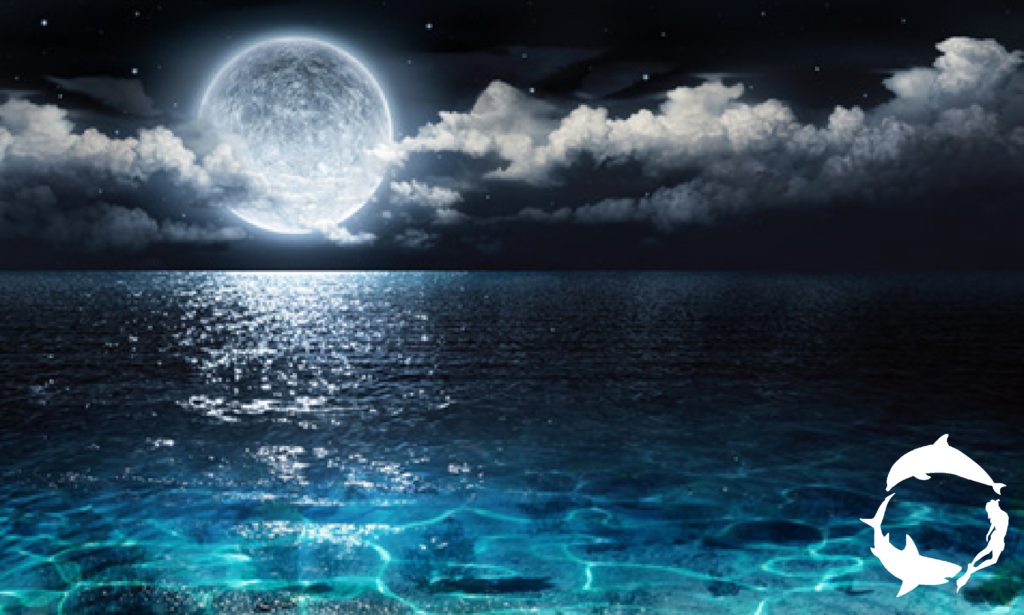
Full moons are often discussed as a “higher-risk” time to enter the ocean, not because the moon “makes sharks aggressive,” but because lunar conditions can change the coastal environment in ways that can increase the chance of shark–prey interactions (and occasionally shark–human interactions). The key is that the moon affects tides and light, both of which can affect when and where fish—and the animals that hunt them—move and feed.
A full moon (and a new moon) is associated with spring tides: higher high tides, lower low tides, and generally stronger tidal currents than during quarter-moon (neap tide) periods. NOAA explains that these more extreme tidal ranges occur when the Sun, Earth, and Moon are roughly aligned, and that tidal current velocities tend to be stronger during these phases. Stronger currents can concentrate nutrients and baitfish, intensify water movement around inlets, sandbars, points, and river mouths, and create short windows where predators feed more actively.
Fish activity is often linked to lunar and tidal cycles, although the exact pattern varies by species and location. Scientific reviews and fisheries analyses describe how lunar-driven environmental changes (including tides and illumination) can influence marine behavior and catch rates—one reason “solunar” ideas persist among anglers. Even if fish are not universally “more active” on every full moon, it is common for feeding opportunities to shift toward tidal-change periods and high-flow areas during spring-tide windows—conditions that can also attract larger predators.
Sharks respond primarily to prey availability, water conditions, and opportunity. There is evidence that some shark behaviors and predator–prey interactions can vary with lunar illumination or phase, but it is not uniform across species or regions. For example, a field study on white sharks and Cape fur seals describes lunar illumination as one of the environmental variables that can influence predator–prey dynamics.
When the discussion turns specifically to human risk, the evidence is mixed and nuanced. A global statistical analysis published in Frontiers in Marine Science reported that shark attacks were more common during periods of higher lunar illumination (i.e., fuller phases) than lower illumination, though it does not prove a direct mechanism. Coverage and summaries from Louisiana State University also describe this association while emphasizing uncertainty about the cause. At the same time, an earlier paper found no statistically significant relationship between lunar cycles and shark attacks. These differences can reflect methods, geography, reporting, and confounders (including when and how many people enter the water).
So what’s the practical takeaway? A full moon can be a reasonable “small added risk factor” because it often coincides with (1) spring tides and stronger currents and (2) brighter nights, which can shift prey movement and predator foraging patterns. But the moon phase is rarely the dominant driver of risk compared with factors like low visibility, proximity to baitfish, fishing activity, time of day, and local conditions.
If you want a simple, safety-minded rule set for full-moon periods (and especially the day before, of, and after the full moon), treat them as times to be more conservative:
– Avoid swimming/surfing near schools of baitfish, jumping fish, birds diving, or marine mammals actively feeding.
– Avoid inlets, river mouths, and murky runoff zones—especially during strong moving tides.
– Give extra space to fishing piers, surf anglers, and areas where people are actively chumming/bleeding bait.
– Avoid dawn/dusk when many coastal predators are more likely to forage and visibility is reduced.
– If conditions are poor (stirred-up water, limited visibility, strong current), consider postponing—even if it’s a “clear” day.
This framing keeps the moon in the right place: not a superstition, not a guarantee, but one environmental signal that can stack with other, more important drivers of shark presence and feeding behavior.
#beach#beachbuddyapp#ocean#sharks#moonlight