Is this really the year of the shark?
In the last month, two shark-related incidents have been reported in California and four in Australia’s New South Wales—six reminders, in a short span, of how quickly an ordinary day at the ocean can turn into tragedy. In Australia, four attacks occurred over roughly 48 hours to three days along the New South Wales coast, triggering widespread beach closures and intensified monitoring.
In California, the December 2025 death of Erika Fox was later confirmed by authorities as caused by a shark attack, and in mid-January 2026 a Northern California surfer was bitten and survived after a violent strike that shredded his board and wetsuit.
There is no “right” way to talk about shark attacks—especially fatal ones—because these aren’t abstract headlines. They are families and friends living through an unimaginable, permanent loss. We are deeply sorry for everyone grieving for these victims.
This topic is also personal for us for another reason: Lucas Ransom. Lucas was killed in a shark attack off Surf Beach, California on October 22, 2010. His death is a central reason Beach Buddy exists.
We built Beach Buddy because we refuse to accept that the only options are silence, fear, or reactive warnings after someone has already been hurt. We believe the public deserves better—faster awareness, clearer context, and practical tools that help people make safer decisions before they enter the water.
What we can agree on, even when emotions run high, is simple: reducing dangerous interactions between humans and sharks in shared coastal spaces is necessary and urgent. How we do that—through research, education, technology, and policy—should be a serious, ongoing public conversation.
Recent events in New South Wales underscore how environmental conditions can change risk rapidly: heavy rain and reduced visibility were cited as factors as authorities urged people to stay out of the ocean and moved quickly to close beaches and expand aerial and electronic monitoring.
Beach Buddy was built to add a layer of prevention and awareness that fits real life. Ocean lovers will keep swimming, surfing, diving, paddling, and fishing. Coexistence has always carried risk. But risk is not fixed—and it is not “unknowable.” Beach Buddy helps by putting useful, real-time context in one place: conditions that influence nearshore activity, surf and weather changes, and practical “before you go” planning information. It also helps you navigate the full beach day—amenities, nearby services, and the kinds of local information people often scramble for only after they arrive.
Just as importantly, Beach Buddy is meant to make education accessible and engaging. Fear alone doesn’t improve safety; understanding does. When people learn patterns—conditions, locations, timing, and how to respond—they make better choices. And better choices reduce the odds of the worst day of someone’s life.
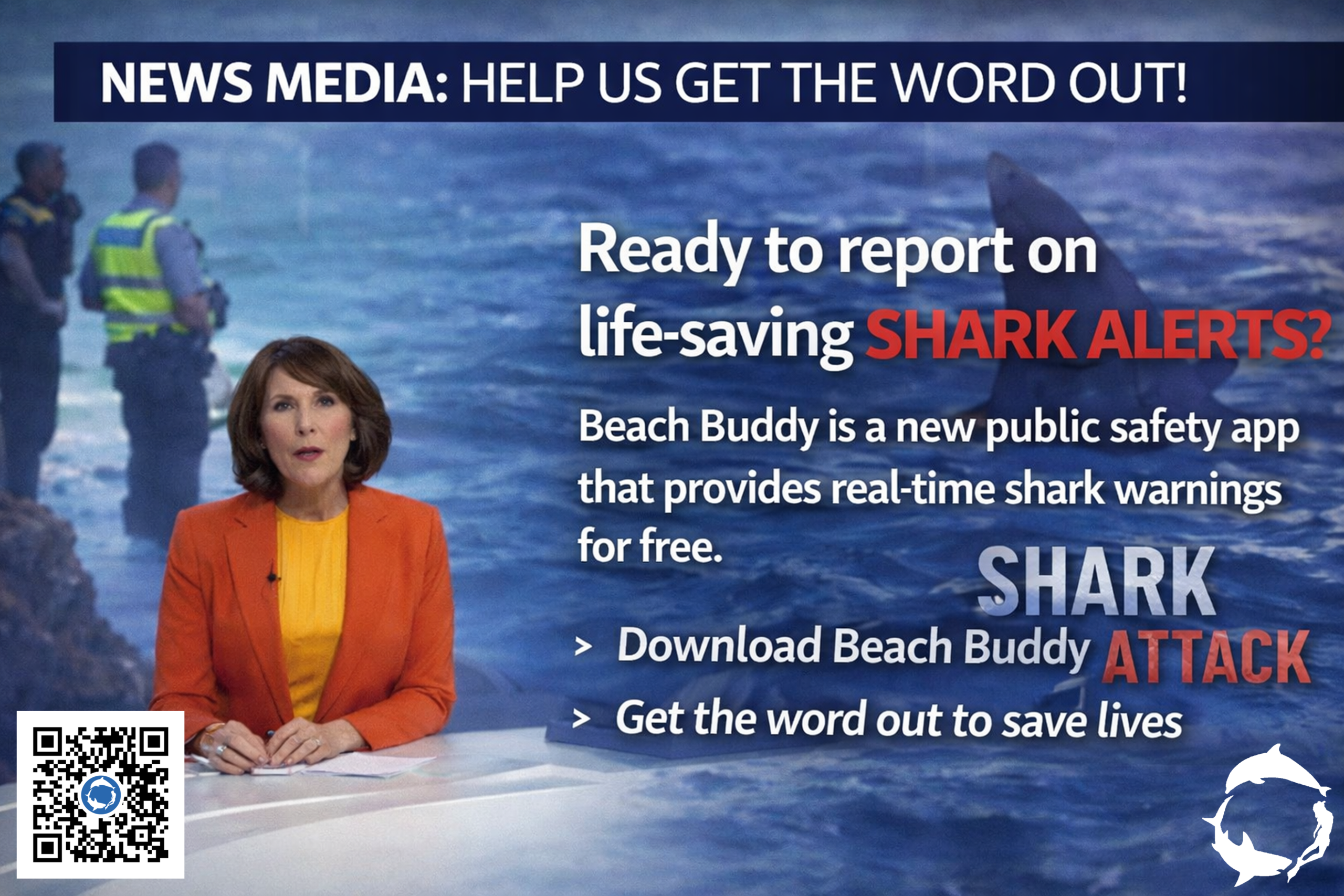
Beach Buddy is still new. That means the biggest challenge isn’t building the technology—it’s awareness. The faster this free app reaches everyday beachgoers, the more lives it can help protect. And the more people who use it, the stronger it becomes: broader usage improves the timeliness and relevance of what the community sees and how quickly patterns surface. Early warning works best when participation is wide.
If you live near the coast, if you travel to beaches, if your kids surf, if you swim for fitness, if you paddle, dive, fish, or simply like walking the shoreline—please help us get Beach Buddy into as many hands as possible. Share it. Encourage the people you care about to check conditions before they enter the water. Normalize “one last check” the same way we normalize buckling a seatbelt.
We can respect sharks and the ocean ecosystem while still taking human safety seriously. Those truths are not in conflict. What’s unacceptable is treating preventable ignorance as inevitable.
#beachbuddyapp#beachbuddy#oceansafety#beachsafety#sharkawareness#australia#california#news#newsworthy